Monday, April 13, 2015
Camp Calculate in Action!
We are coming into our second week of Camp Calculate and your kiddos are doing great! I am enjoying watching them work through problems and share the strategies that they used to get them! We will continue Camp Calculate this week to help us be prepared for the Math STAAR next week. Thank you to all that contributed "goodies" for camp. Those are the kids favorite stations! :)


Monday, March 30, 2015
Camp Calculate
Camp Write Along was a huge success! To continue our camping theme, math camp (Camp Calculate) will begin on Monday next week! We will be reviewing all of the new concepts we have learned this year to make sure that we are ready for the Math STAAR on April 21st. Some of the activities will include fishing for fractions, diving into division, and cavernous conversions. In order to make these activities more fun, I would love to have some snacks along the way for our campers to enjoy. I know that a great deal of you already contributed to our last camp adventure, but one last "camp contribution" would be greatly appreciated! Here is a wish list for Camp Calculate:
- Plain M & Ms
- Chex Cereal
- Pretzels
- Cheeze Itz
- Goldfish
- Teddy Grahams
- Large Marshmallows
- Boxes of Graham Crackers
- Hershey Bars (mini or regular size)
- small bottled water
Sunday, March 22, 2015
Measuring Angles with Protractors
We are finishing out our geometry unit by using protractors to determine the measurement of angles. We have really been having fun with protractors!


Here is a website that will walk you through the steps if you need a refresher: Use-a-Protractor
Kiddos will also need to be able to determine the degree without having a ray line up with the zero line. To do this, you need to skip count from one ray to the other to see the rotation degree. The angle below would measure at about 125 degrees.

They will also need to be able to draw an angle using a protractor.

Finding the missing angle is also a concept we have worked on. Angle COA is a straight angle and therefore measures 180 degrees. We know that angle BOA measures 44 degrees. We can subtract the known angle from the large angle to determine the missing angle (180 - 44 = 136). Angle COB would measure 136 degrees.

Here are some games where kiddos can practice using a protractor:
http://www.mathplayground.com/measuringangles.html
http://www.ixl.com/math/grade-5/measure-angles-with-a-protractor
http://www.mathsisfun.com/geometry/protractor-using.html
https://learnzillion.com/lessons/2973-measure-angles-to-the-nearest-degree-with-protractors
Homework this week will have students drawing angles to a given degree and reading a protractor to determine the degree. It will be due on 3/30. Please let me know if you have any questions!

Here is a website that will walk you through the steps if you need a refresher: Use-a-Protractor
Kiddos will also need to be able to determine the degree without having a ray line up with the zero line. To do this, you need to skip count from one ray to the other to see the rotation degree. The angle below would measure at about 125 degrees.
They will also need to be able to draw an angle using a protractor.
Finding the missing angle is also a concept we have worked on. Angle COA is a straight angle and therefore measures 180 degrees. We know that angle BOA measures 44 degrees. We can subtract the known angle from the large angle to determine the missing angle (180 - 44 = 136). Angle COB would measure 136 degrees.
Here are some games where kiddos can practice using a protractor:
http://www.mathplayground.com/measuringangles.html
http://www.ixl.com/math/grade-5/measure-angles-with-a-protractor
http://www.mathsisfun.com/geometry/protractor-using.html
https://learnzillion.com/lessons/2973-measure-angles-to-the-nearest-degree-with-protractors
Homework this week will have students drawing angles to a given degree and reading a protractor to determine the degree. It will be due on 3/30. Please let me know if you have any questions!
Monday, March 16, 2015
Quadrilaterals and Triangles
We have been studying different geometric figures. Our main focus has been on classifying quadrilaterals and triangles.
A quadrilateral is a four-sided polygon with four angles. There are many kinds of quadrilaterals. The five most common types are the parallelogram, the rectangle, the square, the trapezoid, and the rhombus.

The right triangle has one 90 degree angle and two acute (< 90 degree) angles.

A quadrilateral is a four-sided polygon with four angles. There are many kinds of quadrilaterals. The five most common types are the parallelogram, the rectangle, the square, the trapezoid, and the rhombus.
Here is how they relate to each other:
We have been looking at triangles based on their angles.
Obtuse triangles have one angle that is greater than 90 degrees. Obtuse triangles have only one obtuse angle.
Acute triangles have NO angles greater than or equal to 90 degrees -- all their angles are less than 90 degrees. Acute triangles have three acute angles.
Homework this week will have kiddos classifying each of these geometric shapes. It will be due Monday March 23. Please let me know if you have any questions. Have a great week!
Tuesday, March 10, 2015
Auction Basket
A paper went home with your kiddo a few weeks ago regarding the Spring Carnival Silent Auction Baskets. The classes that bring in
the highest bid on their basket will win a sonic drink for everyone! Our
classes are putting together a "stationary" themed basket. We are asking for
donations to fill our basket. So far, we have only had two items donated and are in need of more!
Please consider donating something to our "stationary" basket. Some donation ideas include notepads, pens, thank you notes, paper, stamps, envelopes, sticky notepads, labels, pencils, and stickers. We need all donations turned into us by April 1st. Please let us know if you have any questions. Thank you!
Friday, March 6, 2015
Meet Mrs. Baker
Hello
Parents!
I wanted to take the opportunity to
introduce myself. My name is Stephanie Baker and I am a student teacher from
Western Governors University. I will be joining Ms. Christian and Mrs. Milot in
working with your child over the next 8 weeks or so. I am so excited to be at
Cox and in 4th grade!
I am getting my dual certification in Special Education and
Elementary Education. My background is in Special ed; I worked as an
instructional aide over the last five years and decided a couple years ago that
I wanted to be a teacher. I absolutely enjoy children and am very passionate
about the teaching profession.
I am married to a very supportive man and have a 9-year-old
son, who is in the third grade. We stay busy with soccer, as I help coach his
team. Go Shockers! We also have 3 adorable dogs that are very much a part of
our family!
I’m very excited to see what the next few months have in
store for us! Please let Ms. Christian or Mrs. Milot know of any questions or
concerns you may have!
Thank you,
Bachelor of Arts, Special Education 6/1/2013
Sunday, March 1, 2015
Angles
We have begun our geometry unit and the kiddos are loving it! We have learned all about angles so far.
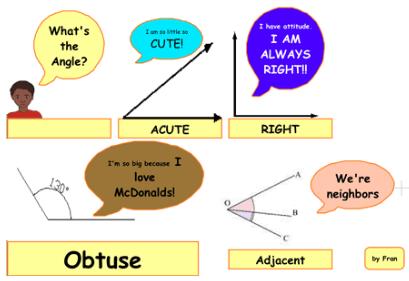
An angle is the intersection of two rays with a common endpoint.
There are four types of angles that we have learned about.
An acute angle is an angle whose measure is less than 90°.

A right angle is an angle whose measure is 90°.

An obtuse angle is an angle whose measure is more than 90°,
but less than 180°.

A straight angle is an angle whose measure is 180°.

Remember that an angle is named using three letters, where the middle letter corresponds to the vertex of the angle. The angle below is <ABC or <CBA. If it is perfectly clear which angle is being named, an angle may be referred to by its vertex letter alone, such as <B.

Here is a fun website that allows you to play around with angles:
Angles
Homework this week will have kiddos identifying types of angles. Please let me know if you have any questions. Have a great week!
An angle is the intersection of two rays with a common endpoint.
There are four types of angles that we have learned about.
An acute angle is an angle whose measure is less than 90°.
A right angle is an angle whose measure is 90°.
An obtuse angle is an angle whose measure is more than 90°,
but less than 180°.
A straight angle is an angle whose measure is 180°.
Remember that an angle is named using three letters, where the middle letter corresponds to the vertex of the angle. The angle below is <ABC or <CBA. If it is perfectly clear which angle is being named, an angle may be referred to by its vertex letter alone, such as <B.
Here is a fun website that allows you to play around with angles:
Angles
Homework this week will have kiddos identifying types of angles. Please let me know if you have any questions. Have a great week!
Subscribe to:
Posts (Atom)