Sunday, January 25, 2015

Perimeter and Area

Last week we worked on perimeter and area. We focused quite a bit on the formulas that are used to find both.


Perimeter is the distance around a two-dimensional shape.

We focused on three formulas to find perimeter:

P = s + s + s (perimeter = side + side + side) - this formula can be sue on any shape


P = 4 x s (perimeter = 4 x side) - this formula works for squares


P = (2 x l) + (2 x w); perimeter = (2 x length) + (2 x width) - this formula works for rectangles


Area is the size of a surface or the amount of space inside the boundary of a flat (2-dimensional) object.

We focused on one formula to find the area of a rectangle:

A = l x w (area = length x width)


Follow this link if you want more clarification on calculating perimeter and area:


Homework this week will have your kiddo calculating perimeter and area. I expect them to write down the formula that they choose to use before they solve. Ask them about the three F's in math.

Please let me know if you have any questions! I am happy to help in any way I can!

Monday, January 19, 2015

Data Representations

This week we have learned about three new ways to represent data. We have learned about dot plots, frequency tables, and stem-and-leaf plots.

A dot plot is a graphical display of data using dots. It is very similar to pictographs.


A frequency table is a table that shows a set of numbers/scores and their frequency (how many times each one occurs).

Frequency Distribution

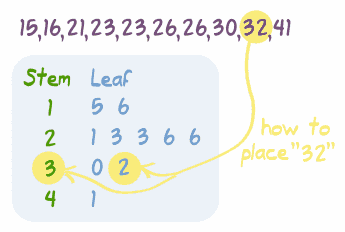
A stem-and-leaf plot is a plot where each data value is split into a "leaf" (usually the last digit) and a "stem" (the other digits). For example "32" is split into "3" (stem) and "2" (leaf). The "stem" values are listed down, and the "leaf" values are listed next to them. This way the "stem" groups the scores and each "leaf" indicates a score within that group.
Stem-and-Leaf Plot

Here are the basic steps to creating a stem-and-leaf plot:

Last week, we created these three data representations using data from final scores of the Dallas Cowboys games. They did a great job on this assignment and really seemed to enjoy it!

Homework this week will consist of something similar. Your kiddo will need to research some data (height of people, scores of game, age of friends, etc.) and create a dot plot, frequency table, and stem-and-leaf plot to represent this data. They will then need to come up with three questions that can be answered using this data. An example question might be: How many more students scored 80% or greater on the test than 70% or lower? This assignment will be due on Monday, January 26th. 

Please let me know if you have any questions!

Sunday, January 11, 2015

Decimals

We have been working on decimals this week. 


They tie in perfectly to fractions and the transition was smooth!


We are able to illustrate decimals,


Add and subtract decimals,


Compare decimals,
                                            

And relating decimals to money.
                                                      

We have also been practicing writing them in standard form, word form, expanded form, and expanded value.

Standard form: 31.25

Word form: thirty two and twenty-five hundredths

Expanded form: 30 + 1 + 0.2 + 0.05

Expanded value: (3 x 10) + (1 x 1) + (2 x 0.1) + (5 x 0.01)


Homework this week will have us practicing all these skills! Please let me know if you have any questions.

Have a great week!

Sunday, January 4, 2015

Mixed Numbers and Improper Fractions

Mixed Numbers

A mixed number is a combination of a whole number and a fraction. For example, if you have two whole apples and one half apple, you could describe this as 2 + 1/2 apples, or 2 1/2 apples.


Writing Mixed Numbers as Fractions

This mixed number can also be expressed as a fraction. Each whole apple contains two half apples. Your two whole apples are also four half apples. Four half apples plus one half apple is five half apples. So you have 5/2 apples.

To put this another way: to turn a mixed number into a fraction, multiply the whole number by the denominator (the bottom part), and add the result to the numerator (the top part).

2 1/2 = ?
  Multiply the whole number by the denominator.
    The whole number is 2.
    The denominator is 2.
    2 x 2 = 4.
  Add the result to the numerator:
    The numerator is 1.
    4 + 1 = 5
  The numerator is 5. The denominator remains 2.
2 1/2 = 5/2

More Examples:

Changing Mixed number to an Improper Fraction- Anchor chart


Proper and Improper Fractions

A fraction in which the numerator is smaller than the denominator, like 1/3 or 2/5 is called a proper fraction. A fraction in which the numerator is larger than or equal to the denominator, like 5/2, 17/3, or 6/6 is called an improper fraction. (To put it another way, a fraction with a value less than 1 is a proper fraction. A fraction with a value greater than or equal to 1 is an improper fraction.)

As shown above, mixed numbers can be written as improper fractions. Similarly, improper fractions can be written as mixed numbers.


Writing Improper Fractions as Mixed Numbers

To write an improper fraction as a mixed number, divide the numerator (top part) by the denominator (bottom part). The quotient is the whole number, and the remainder is the numerator.

How would you express 17/4 as a mixed number?
  Divide the numerator by the denominator:
  17 ÷ 4 = 4, with a remainder of 1
  The quotient, 4, is the whole number. The remainder, 1, is the numerator. The denominator remains 4.
17/4 = 4 1/4

More Examples:


Here is a comparison of the conversions side by side.


Homework this week will have your kiddo practicing this concept. It will be due on Monday December 12th. Please let me know if you have any questions!

Thursday, December 18, 2014

Wax Museum and Dinner Interview

The time is near and excitement is in the air! Our Wax Museum is always anticipated and enjoyed! Please join us between 10am-11am and be impressed with our work! 

Expectations:

Wax Museum- Students will present their persons of influence in 1st person form, as an autobiography and in costume (need not be elaborate). Each student drafted a blurb to practice in class. While memorization is not mandatory and students may refer to their speech, reading with no eye contact is discouraged. 

Menu/Interview- 

A letter was sent home giving directions for this assignment. Students were asked to imagine hosting a dinner for their person of influence. With careful consideration of lifestyle, accomplishments, and habits, what do you think your person would want to eat and why? Ideas can be literal (athletes with lean diets, proteins, etc) or figurative (Christopher Columbus with Boston Cream Pie). 
Students are then asked to create a menu (layout is up to you, we looked at several examples on the Internet) and list menu items for the evening: salad/soup or appetizer, main dish, and dessert. Menus are to be illustrated (drawn, cut out, or printed) and inviting. Again, size, layout, and materials are up to you. 
In addition, students are to bring 3 questions to ask their "person", if they were given the opportunity.

Have fun! I can't wait to see the creativity explode!


Sunday, December 14, 2014

Comparing Fractions

We have moved into working on comparing fractions. There are numerous ways that we have learned to do this. Homework this week (due January 5th) will have students using some of these methods to compare fractions. Here are the ways that we have been working on:

Draw a picture. This strategy can work with smaller fractions, but starts to get complicated with larger fractions.


Compare with like denominators. When the denominators are the same, you are comparing the numerator. The larger numerator will be the larger fraction.


Compare with like numerators. When the numerators are the same, you are comparing the denominator. The larger the denominator, the smaller the pieces will be. Therefore, the smaller denominator will give you the larger fraction.


Compare to a benchmark fraction. Determine how the fraction relates to ½ and that can help determine the larger or smaller fractions. We have also put them on a number line to help us clearly see how they compare.


Compare missing pieces. The fraction with the smallest piece missing will be the largest fraction.

visual image of fractions


Change one denominator to make a common denominator. Sometimes you only have to change one of the denominators to make common denominators.


Change both denominators to a common denominator. This allows kiddos to then compare fractions with like denominators. These are a few strategies we have talked about relating to this:

·         Change both denominators to a common denominator.


·         Multiply the denominators by each other to find a common denominator.


·         Find the least common denominator. Finding the LCD has kiddos finding the least common multiple (the smallest positive number that is a multiple of two or more numbers).


Steps to find the LCD (Least Common Denominator)

Example: Compare 1/2, 1/3, 1/5

1. List the multiples of each denominator. Make a list of at least five multiples for each denominator in the equation. Each list should consist of the denominator numeral multiplied by 1, 2, 3, 4, and so on.

Multiples of 2: 2 x 1 = 2; 2 x 2 = 4; 2 x 3 = 6; 2 x 4 = 8; 2 x 5 = 10
Multiples of 3: 3 x 1 = 3; 3 x 2 = 6; 3 x 3 = 9; 3 x 4 = 12; 3 x 5 = 15
Multiples of 5: 5 x 1 = 5; 5 x 2 = 10; 5 x 3 = 15; 5 x 4 = 20; 5 x 5 = 25

2. Identify the lowest common multiple. Scan through each list and mark any multiples that are shared by each original denominator. After identifying the common multiples, identify the lowest denominator.

Note that if no common denominator exists at this point, you may need to continue writing out multiples until you eventually come across a shared multiple.
Example: 2 x 15 = 30; 3 x 10 = 30; 5 x 6 = 30
The LCD = 30

3. Rewrite the original equation. In order to change each fraction in the equation so that it remains true to the original equation, you will need to multiply each denominator by the same factor used to multiply the corresponding denominator when reaching the LCD. Be sure to multiply the numerator AND denominator of each fraction by the factor.

Example: 15 x (1/2); 10 x (1/3); 6 x (1/5)

New mathematical statement: 15/30 > 10/30 > 6/30


Please let me know if you have any questions. 

Wednesday, December 10, 2014

Upcoming Events/Dates

Yearbooks

Yearbooks are for sale starting this week. Order forms will go home in Thursday folders. Parents have the option of ordering online this year! There are tons of upgrades to the yearbook, so you can “personalize” it for your child. Base price for the yearbook is $18.00.

Parents can order online by following the below link:


Yearbook ID for Cox: 12373015


Field Trip to Fort Worth

The date for our Fort Worth field trip has been finalized and we are officially going on May 6th. Please be sure to put that date on your calendar. They 2nd payment (for those who are paying in installments) is due January 8th. 


Candy Cane-Grams

Thank you so much for all the boxes of mini candy canes! You are amazingly supportive parents and we greatly appreciate you! Candy cane-grams go on sale Monday (12/15) - Wednesday (12/17) from 7:00-7:20 and are only fifty cents! You can even purchase one to send to your kiddo from you! :)


Math and Science Night

Please be sure to mark your calendar for Math and Science Night on January 29th from 6:00-7:00. We will be playing fun games, serving food, and rewarding prizes! We hope to see you there! Please let your homeroom teacher know if you will be attending by Friday 12/19.  


Pajama Day

Friday (12/12) marks the end of our pajama drive. Please be sure to get all pajama donation in by Friday. To celebrate all the pajamas collected, we are having a pajama day! Students are free to wear pajamas on Friday, but they need to still wear regular shoes (no slippers) for safety reasons.   


Science Fair

Cox will be participating in another Science Fair this year. Be on the lookout for information coming home soon regarding dates and guidelines. I will be sure to convey more information as it becomes available.